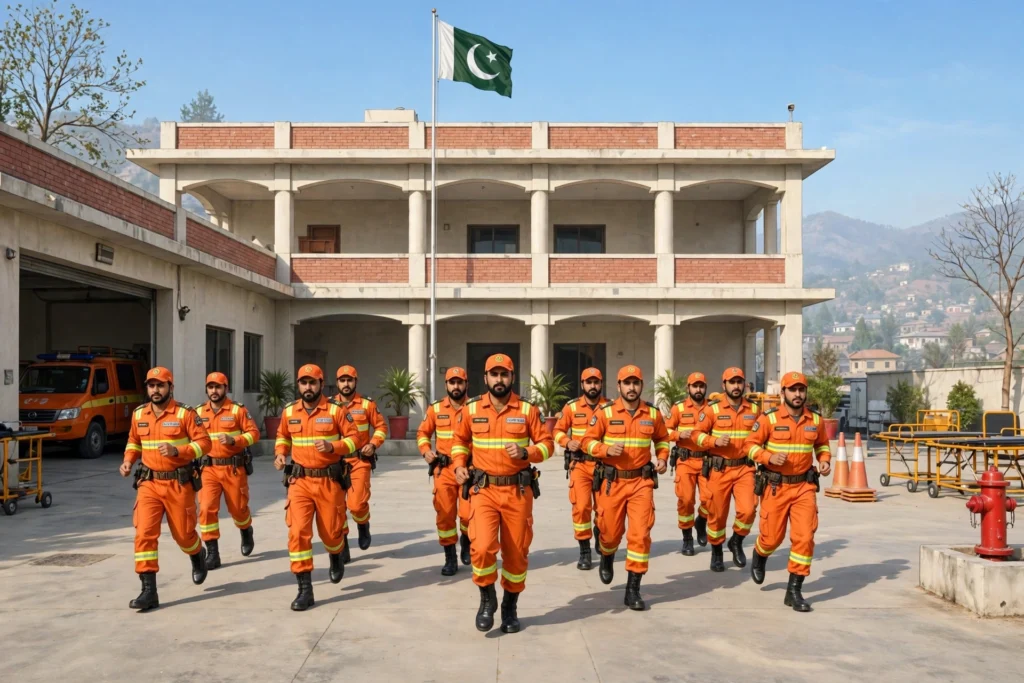
Rescue 1122 Jhang has held monthly physical fitness tests for its staff at every station across the district, putting rescuers through their paces to make sure they stay ready for any emergency.
The tests were organised by the Punjab Emergency Service, Rescue 1122 Jhang, at all of the district’s rescue stations. Their purpose is to maintain the rescuers’ physical health, agility, endurance and professional skills, so that they are prepared to deal with every kind of emergency situation.
During the fitness tests, staff were assessed on running, physical fitness, stamina and other physical activities. On the occasion, rescuers were also briefed on the importance of exercising regularly, adopting a healthy lifestyle and maintaining their physical fitness.
District Emergency Officer Rescue 1122 Jhang, Engineer Sultan Mahmood, said physical fitness is an essential part of a rescuer’s professional life. Only a healthy, agile and physically strong rescuer can perform effectively in difficult and demanding conditions and play a part in saving precious human lives, he said.
He added that regular exercise and physical fitness tests improve not only physical health but also mental focus, self-confidence, discipline and professional performance. Rescue staff should pay attention to their physical fitness every day, he said, so that a timely and effective response is ensured in accidents, natural disasters and other emergency situations.
Engineer Sultan Mahmood expressed the resolve that the series of training and fitness sessions to improve the professional skills and physical capacity of rescue staff will continue regularly, so that the public receives timely and quality rescue services in emergencies.
The emphasis on fitness follows a demanding month for the service. In October, Rescue 1122 Jhang responded to 7,641 emergencies across the district, as this site reported on 4 November, rescuing 7,661 people. That workload — road accidents, medical emergencies, fires and other incidents — is the reason the service treats fitness as a working requirement rather than a formality.
A rescue worker’s day can change in a moment. One call may mean carrying a patient down a narrow staircase, another may mean working at the scene of a crash in heavy traffic, and a third may mean responding to a fire or a building collapse. In each case, the rescuer’s own strength and stamina decide how quickly help reaches the person in trouble and how safely the rescue itself is carried out.
That is why the monthly tests cover more than a single exercise. Running tests endurance, strength work tests the ability to lift and carry, and the wider assessment gives officers a picture of each rescuer’s overall readiness. The message given to staff alongside the tests — to exercise regularly and to live healthily — is meant to keep that readiness between one monthly test and the next.
The fitness programme also fits with the service’s broader training work in the district. Regular sessions are intended to keep skills sharp as well as bodies fit, so that when an emergency call comes in, the crew that arrives is both trained and physically able to do the job.
For the public, the tests are a quiet reassurance. The rescuers who arrive at a road accident or a medical emergency in Jhang have been checked, month by month, to make sure they are fit for the work. The district emergency officer’s commitment that the sessions will continue regularly means that check will not be a one-off.
Source: The Jhang Times, “Rescue 1122 Jhang ke tamam stations par ahalkaron ke mahana physical fitness test” (monthly physical fitness tests of staff at all Rescue 1122 Jhang stations), published 6 November 2026.