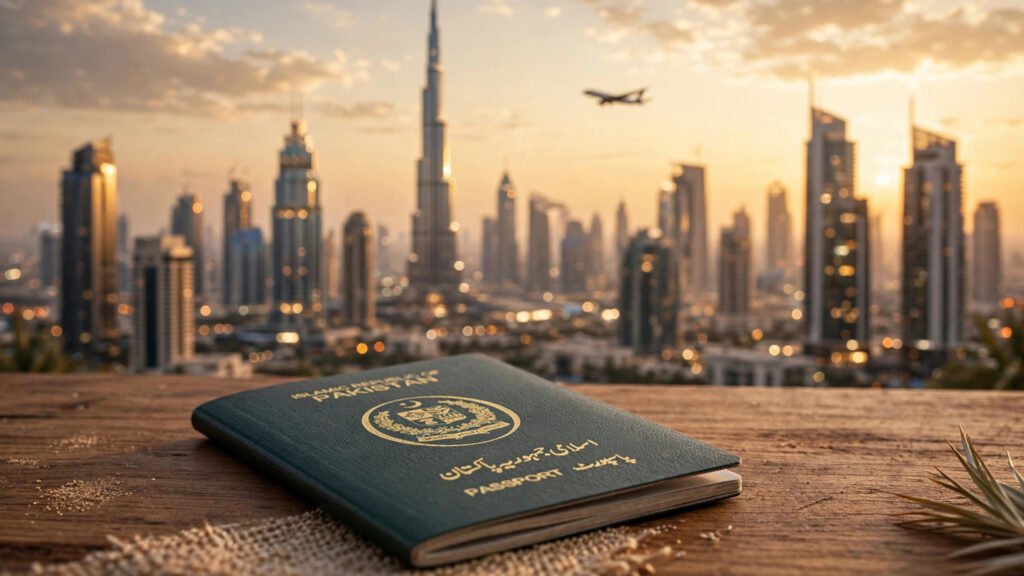
Dubai is the number-one holiday destination for Pakistani travellers — and the visit visa is the door that gets you there. The good news is that the UAE keeps the process simple for Pakistanis: no embassy interview, no advance biometrics, and the whole thing is processed online. The bad news is that misinformation is everywhere, and a small document mistake is the most common reason applications get delayed or rejected.
This guide gives you the complete, practical picture for 2026: which visa types exist, exactly what documents you need, what the fees look like in rupees, and the step-by-step process from document collection to landing at Dubai International Airport.
How the Dubai visa works for Pakistani citizens
Unlike many countries, the UAE does not issue tourist visas through its embassies in Pakistan. You cannot walk into a UAE embassy in Islamabad or Karachi and apply. Instead, a sponsor based in the UAE applies on your behalf through the online immigration system, and your visa arrives as an e-visa — a PDF you print and show at immigration.
A sponsor is simply the UAE-side entity that stands behind your visit. For tourists, that is almost always one of three:
- A UAE airline — Emirates, Etihad, FlyDubai or Air Arabia. If you book your flight with them, you can add the visa to your booking.
- A licensed UAE travel agency — most Pakistanis apply through a Pakistani travel agent who partners with a UAE-side agency.
- A UAE resident relative or friend — a family member with a valid UAE residence can sponsor your visit visa.
Because the visa is electronic, you never surrender your passport to anyone. If an agent asks to keep your original passport for days, that is a red flag — walk away.
Visa types: which one do you need?
| Visa type | Stay allowed | Best for |
|---|---|---|
| 30-day single entry | 30 days | First-time holiday trip |
| 30-day multiple entry | 30 days per entry | Repeat visits in a short window |
| 60-day single entry | 60 days | Longer family visits, job hunting |
| 60-day multiple entry | 60 days per entry | Business travellers |
| 48/96-hour transit | 2–4 days | Layovers turned into mini-trips |
| 5-year multiple entry | 90 days per visit | Frequent travellers |
For a typical holiday, the 30-day single-entry visa is the right choice — it is the cheapest and the most commonly issued.
Documents you need (checklist)
Gather these before you approach an agent. Blurry scans and missing items are the top reasons applications get held up.
- Pakistani passport — valid for at least 6 months beyond your entry date, with a clear colour scan of the bio-data page.
- Recent passport-size photograph — white background, studio-quality. No selfies, no cropped wedding photos.
- CNIC copy — clear colour scan of both sides. UAE immigration specifically lists an identity card for Pakistani applicants.
- Confirmed return ticket — a real onward/return booking. Many airlines and agencies will not process a visa without it.
- Hotel booking or accommodation proof — a confirmed hotel reservation, or your sponsor’s invitation letter if staying with family.
- Bank statement — not always required, but commonly asked: the last 3–6 months showing steady activity and a healthy balance. A commonly quoted figure is PKR 1.5–3 lakh minimum.
- Travel insurance — valid in the UAE for your full stay. Some sponsors require it before they file.
- NOC from your employer — only if your sponsor or agent asks for it; not a universal requirement.
Keep everything digital, high-resolution and under one folder. If your agent asks for additional documents, ask them why — requirements do vary slightly between issuing authorities (GDRFA Dubai vs federal ICP), so confirm with your own sponsor.
Dubai visa fee from Pakistan in 2026 (approximate)
Fees move with the PKR-AED exchange rate and the agency you use, so treat these as a planning range, not a promise:
- 30-day single entry: roughly PKR 22,000–40,000
- 30-day multiple entry: roughly PKR 40,000–48,000
- 60-day single entry: roughly PKR 35,000–70,000
- 60-day multiple entry: roughly PKR 62,000–72,000
- 96-hour transit: roughly USD 150 equivalent
- 5-year multiple entry: roughly PKR 90,000–130,000
Agency prices include the UAE government fee, the sponsor’s service charge and the agency’s own margin. Get the total price in writing before you pay — reputable agents quote one all-in figure with no “extra processing” surprises later.
Processing time: how long does it take?
Normal processing is typically 2–5 working days after your documents are submitted. Express/urgent processing of 24–48 hours is usually available for an extra charge. Apply at least two weeks before your travel date to stay comfortable — visa approvals can slow down around Eid, summer holidays and New Year when application volumes spike.
Step-by-step: how to apply
Step 1 — Choose your sponsor route. Airline-attached visa (if flying Emirates, Etihad, FlyDubai or Air Arabia), a licensed travel agent, or a resident relative. Each works; the airline route is the simplest for first-timers.
Step 2 — Collect your documents. Passport scan, photo, CNIC, return ticket and hotel booking. Send clear colour copies — blurry scans are the number-one delay.
Step 3 — Submit to your sponsor or agent. They review your documents and confirm the right visa category for your trip.
Step 4 — Track the filing. Your agent submits the application to the UAE visa portal (ICP or GDRFA). Ask for your application or file number so you can follow up.
Step 5 — Receive your e-visa by email. It comes as a PDF. Print it, save a copy on your phone, and verify that your name and passport number match exactly.
Step 6 — Travel. Show the printed e-visa at check-in and at UAE immigration. It lets you enter anywhere in the UAE — Dubai, Abu Dhabi, Sharjah and all other emirates.
Practical tips that save you money and stress
Book the ticket and visa together. If you fly a UAE airline, adding the visa to the booking is often the cheapest and most transparent route.
Double-check names and numbers. A single wrong digit in the passport number on the e-visa can mean being stopped at immigration. Check the PDF the moment it arrives.
Do not overstay. Overstay fines in the UAE are charged per day and add up fast — and an overstay record hurts every future application.
Watch the entry window. Your e-visa typically must be used within a set period after issue (commonly 30–60 days). Do not apply three months before you travel.
Beware of “guaranteed visa” sellers. No agent can guarantee approval — the decision belongs to UAE immigration. Anyone promising 100% approval for a premium fee is selling you confidence, not a visa.
Frequently asked questions
Do Pakistani citizens need a visa for Dubai?
Yes. Pakistani passport holders need a visa before travelling to the UAE. It is issued as an e-visa through a UAE-based sponsor — there is no visa-on-arrival for ordinary Pakistani passports.
Can I apply for a Dubai visa without a sponsor?
No. UAE embassies in Pakistan do not issue tourist visas. You must apply through a UAE sponsor — an airline, a licensed travel agency or a UAE resident relative.
How much bank balance is needed for a Dubai visa from Pakistan?
There is no single published figure, but agencies commonly recommend a bank statement showing PKR 1.5–3 lakh with steady activity. A fresh lump-sum deposit looks suspicious — show a real, active account.
How long does a Dubai visit visa take for Pakistanis?
Normally 2–5 working days; 24–48 hours with express processing. Apply at least two weeks before your flight.
Can I visit Abu Dhabi or Sharjah on a Dubai-issued visa?
Yes. A UAE visit visa allows entry anywhere in the country, whichever emirate issued it.
Conclusion
The Dubai visit visa is one of the most straightforward visas a Pakistani traveller can get: six documents, one sponsor, and usually under a week of waiting. The entire game is preparation — sharp scans, a genuine return ticket, a healthy bank statement and a reputable sponsor. Get those right and the visa is a formality. Start by deciding your sponsor route and collecting your documents this week, and your Dubai trip is one quiet email away.