
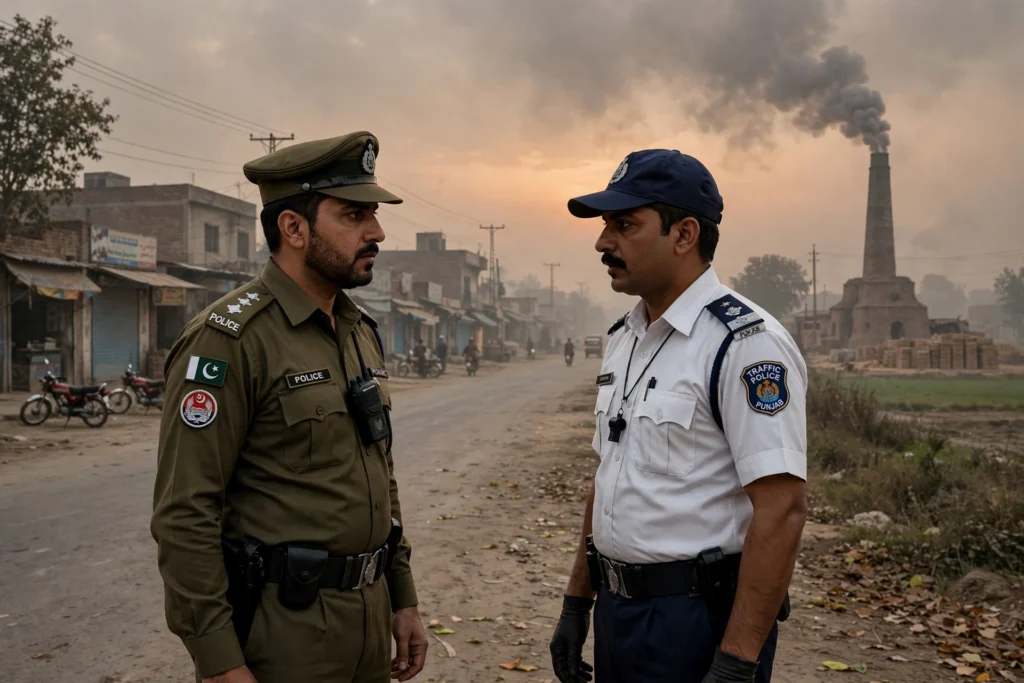
Jhang’s district administration has stepped up its campaign against smog, ordering swift action against brick kilns that break zigzag technology rules, farmers who burn crop residue, and vehicles that belch smoke onto the district’s roads.
Deputy Commissioner Captain (retd) Abdul Rehman chaired a meeting to review the anti-smog measures under way across the district. The meeting was held on the directions of Punjab Chief Minister Maryam Nawaz Sharif, and it examined the steps already taken before instructing the departments concerned to move faster.
During the meeting, the deputy commissioner ordered immediate action against brick kilns operating in violation of zigzag technology. He also directed the departments to intensify action against those responsible for burning crop residue, smoke-emitting vehicles and industrial pollution, saying the drive must be pursued on every front at once.
The deputy commissioner instructed officers of the traffic police, the Suthra Punjab Agency and WASA Jhang to make sure the anti-smog measures are implemented effectively and to tighten monitoring in the field. He told all departments concerned to fulfil their responsibilities and to implement the government’s instructions strictly, adding that no negligence would be tolerated in the effort to end environmental pollution and give citizens a clean environment.
The orders were followed the same day by action on the ground. Additional Deputy Commissioner (Enforcement) Rab Nawaz Chadhar, accompanied by officers of the agriculture department, visited the Pabbar Wala area of Chund Bharwana, where crop residue was being burnt. Taking notice of the violation of the anti-smog laws, he ordered a first information report (FIR) to be registered against those responsible on the spot and directed the officers concerned to take immediate legal action.
The additional deputy commissioner made clear that there is a complete ban on burning crop residue and that legal action will be taken without discrimination against anyone who breaks it. He said all departments concerned must play their part for a smog-free Jhang, and that citizens also have a role to play in preventing environmental pollution.
The crackdown comes as Jhang’s air quality remains among the worst in Punjab. Earlier today, this site reported that Jhang topped the province’s air pollution chart with an air quality index reading of 678, as smog tightened its grip across Punjab. The district’s own contribution to the problem is part of the picture too: satellite monitoring reported this week counted 676 crop-fire detections in Jhang between 1 and 29 October, as farmers cleared fields after the harvest.
That is the background against which the administration is now acting. Brick kilns that have not converted to zigzag technology burn more fuel and release more smoke than compliant kilns, while crop-residue burning sends thick smoke across the fields and into nearby towns. Smoke-emitting vehicles add to the load on the district’s roads, and industrial units that ignore the rules make the problem worse still.
For residents, the practical effect of the orders should be visible in the coming days: enforcement teams in the field, action against kilns that break the rules, and FIRs where crop residue is set alight. The administration has not published a list of kilns or vehicles proceeded against so far, and this article does not invent one. What is confirmed is the direction from the top of the district administration and the first enforcement action that followed it.
The anti-smog drive is a district-wide effort, and its success will depend on whether the orders given in the meeting are followed through in the field. The deputy commissioner’s warning that negligence will not be tolerated sets the tone, but residents will judge the campaign by what changes in the air they breathe.
Source: The Jhang Times, “Jhang mein insdad-e-smog muham tez” (anti-smog campaign intensifies in Jhang) and “ADC (Enforcement) Rab Nawaz Chadhar ka Chund Bharwana mein chhapa” (ADC Enforcement raids Chund Bharwana), both published 6 November 2026.
