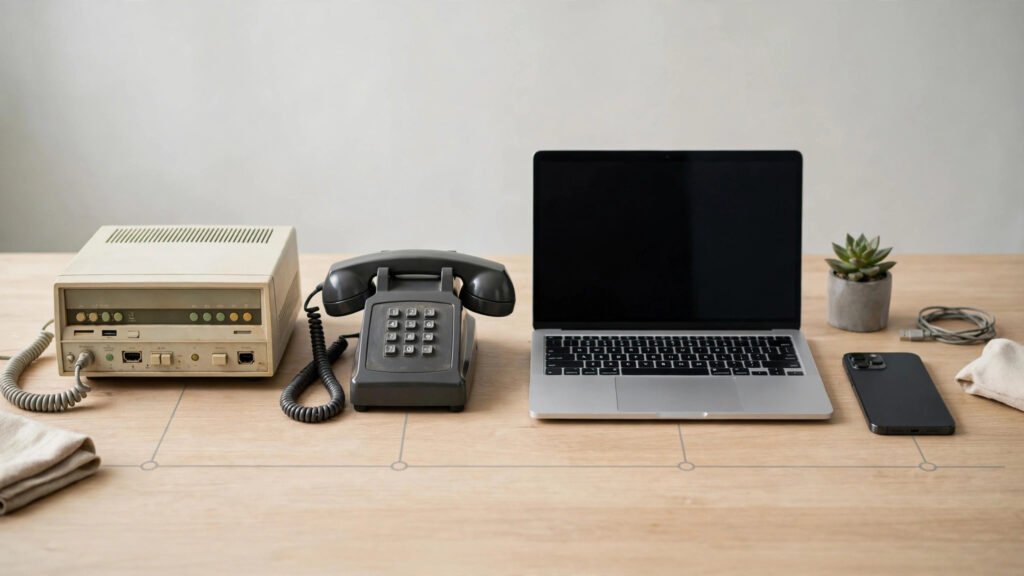
Today, the internet is part of daily life in Pakistan. We use it for study, work, shopping, banking, and entertainment. But the internet in Pakistan has a short and remarkable history. In less than thirty years, it grew from a slow, expensive connection used by a few people into a service that reaches millions of homes and phones. This guide looks at how that happened.
The Early Years: 1990s Dial-Up
The internet first reached Pakistan in the early 1990s, mainly through universities and research institutions. The first commercial internet services appeared in the mid-1990s, when private companies began offering dial-up connections. Dial-up worked through a telephone line and a modem. It was slow, noisy, and expensive. A single page could take a minute to load, and you could not use the phone and the internet at the same time.
In those early years, only a small number of people could afford the internet. Internet cafes became popular in cities, where students and young people paid by the hour to check email, chat, and browse. For most Pakistanis, the internet was still something they had heard about rather than something they used.
The 2000s: Broadband Arrives
The early 2000s brought the first real change. DSL broadband arrived, offering always-on connections that were faster than dial-up and did not block the telephone line. Pakistan Telecommunication Company Limited (PTCL) became the main provider, and private companies followed. Internet speeds improved, and the cost slowly came down.
During this decade, internet cafes spread to smaller cities and towns. Email became common for business and education, and the first Pakistani websites, news portals, and forums appeared. Universities began offering computer science degrees, and a generation of young Pakistanis started learning about the digital world.
Mobile Internet: 3G and 4G Change Everything
The biggest turning point came with mobile internet. When 3G and later 4G services launched in Pakistan in 2014, the internet stopped being something you used at a desk. Suddenly, millions of people could get online from a phone, anywhere, at any time.
Cheap Android smartphones made this possible. Mobile operators competed on data packages, and prices fell. Social media apps like Facebook, WhatsApp, and later TikTok and YouTube became part of everyday life. For many Pakistanis, the phone was their first and only computer.
Fibre Broadband and the Modern Era
In recent years, fibre-optic broadband has spread in major cities. Fibre offers much faster and more stable speeds than old DSL, which matters for online classes, remote work, video calls, and streaming. At the same time, 4G coverage has expanded into smaller towns and rural areas, though some remote regions still have limited access.
Today, Pakistan has tens of millions of internet users, and the number keeps growing. Online banking, e-commerce, freelancing, and digital payments have all become normal, especially among young people.
How the Internet Changed Pakistan
The internet changed almost every part of life in Pakistan:
- Education: Students now attend online classes, watch lectures on YouTube, and apply for scholarships and admissions online.
- Work: Freelancers in Pakistan earn from clients around the world through platforms like Fiverr and Upwork, and remote jobs have become a real option.
- Business: Small shops sell on Daraz and Facebook, and digital payments have made it easier to buy and sell without cash.
- Communication: Families stay connected through WhatsApp and video calls, even when members live abroad.
- News and information: People now get news instantly on their phones instead of waiting for the evening bulletin.
Challenges That Remain
Despite the progress, challenges remain. Internet speeds in Pakistan are still slower than in many countries, and prices for high-speed packages are high for low-income families. Some rural areas have weak or no coverage. Power cuts disrupt connections, and occasional internet shutdowns affect work and study. Digital literacy is also uneven: many people can use social media but need training to use the internet for learning and earning.
What Comes Next?
The next chapter of the internet in Pakistan is likely to include 5G, wider fibre coverage, and more digital services in health, education, and government. As prices fall and coverage grows, more Pakistanis will come online, especially in rural areas. The challenge is to make the internet faster, cheaper, and more useful for everyone, not just those in big cities.
Frequently Asked Questions
When did the internet start in Pakistan?
The internet reached Pakistan in the early 1990s through academic and research networks, and the first commercial dial-up services appeared in the mid-1990s.
When did 3G and 4G launch in Pakistan?
3G and 4G services were launched in Pakistan in 2014, after the government auctioned mobile broadband licences. This was the turning point for mobile internet in the country.
What is the difference between DSL and fibre internet?
DSL uses old copper telephone lines and offers limited speeds. Fibre uses light signals through glass cables and delivers much faster, more stable internet, especially for streaming and video calls.
Why is internet speed slow in some parts of Pakistan?
Speed depends on the network in your area, the package you buy, and the quality of local infrastructure. Rural areas and old copper-line connections are usually slower than fibre in big cities.
Conclusion
The history of the internet in Pakistan is a story of rapid change: from slow dial-up in the 1990s to broadband in the 2000s, and then to 3G, 4G, and fibre that put the internet in millions of pockets. It has transformed education, work, business, and communication. Challenges remain, but the direction is clear. The internet is no longer a luxury in Pakistan. It is a basic part of modern life, and its next chapter will reach even more people.