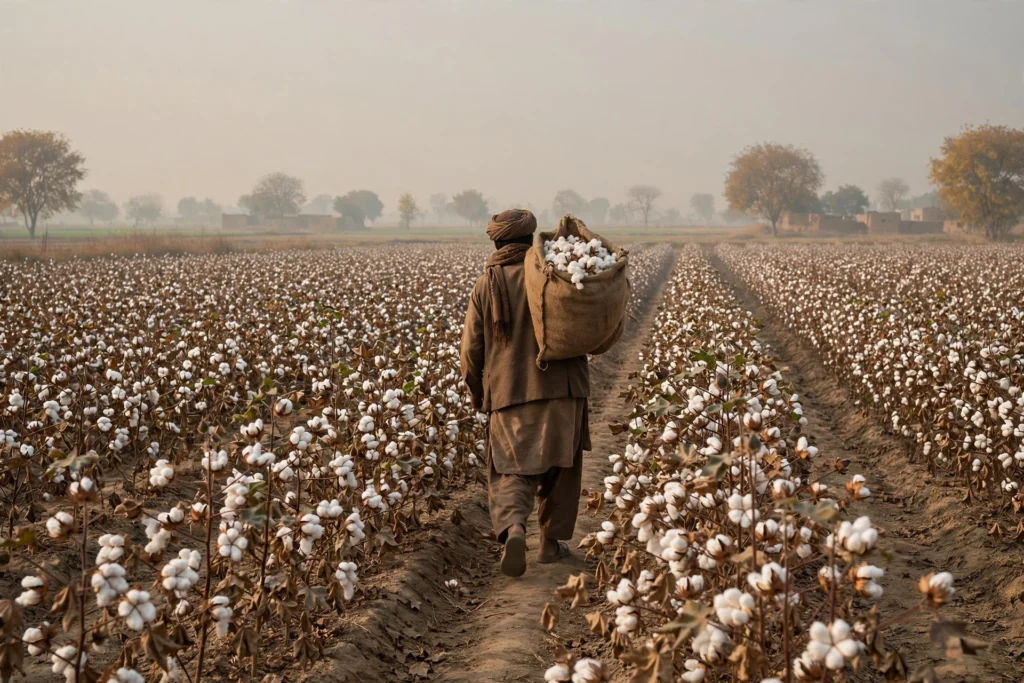
Jhang’s cotton arrivals fell sharply this season, dropping 46.23 per cent to 0.006 million bales by 31 October 2026, down from 0.011 million bales at the same point last year. The figure comes from the latest data released by the Pakistan Cotton Ginners Association (PCGA), and it places Jhang among the central Punjab districts where cotton continues to lose ground even as the national crop recovers.
The national picture, reported on 4 November, looks better than Jhang’s. Ginning factories across Pakistan received 4.742 million bales by the end of October, up 6.88 per cent from 4.437 million bales in the corresponding period last year — an increase of 0.305 million bales. But that recovery was concentrated in the south. The Sindh Zone, which includes Balochistan under the PCGA’s reporting format, contributed 2.743 million bales, up 8.52 per cent, and accounted for more than 70 per cent of the national increase. Sindh alone recorded 2.539 million bales, while Balochistan grew 35.41 per cent to 0.204 million bales.
Punjab as a whole recorded about 1.998 million bales against 1.909 million last year, a rise of 4.71 per cent and a 42.15 per cent share of national arrivals. Within Punjab, however, the story splits. The province’s traditional cotton belt held up better than its non-core districts, and Jhang sits firmly in the second group. Ten districts across the Sahiwal, Faisalabad and Sargodha divisions together recorded only 0.159 million bales, down from 0.218 million last year — a fall of 26.97 per cent — and their share of national arrivals slipped to just 3.36 per cent.
Jhang’s neighbours tell the same story. Bhakkar registered the sharpest decline of all, falling 61.71 per cent to 0.006 million bales from 0.017 million. Sahiwal dropped 31.94 per cent to 0.059 million bales from 0.087 million. Faisalabad fell 25.97 per cent to 0.010 million bales, and Toba Tek Singh declined 25 per cent to 0.039 million bales. In the same dataset, Pakpattan, Okara and Sargodha reported zero cotton arrivals for the second consecutive year, while Kasur recorded only 0.0012 million bales. Jhang’s 0.006 million bales — about 6,000 bales — is now at the same low level as Bhakkar’s, a striking change for a district that once counted cotton among its main cash crops.
Arrivals also slowed in the second half of October. Between 16 and 31 October, ginning factories received 0.661 million bales, up only 3.08 per cent from about 0.641 million in the same fortnight last year — below the season’s overall growth rate. Punjab contributed 0.360 million bales in that fortnight, or 54.5 per cent of the total.
Cotton Ginners Forum Chairman Ihsanul Haq pointed to two structural reasons for the weakness in peak-season arrivals. Pakistan failed for the second consecutive year to record one million bales in any single fortnight during the peak September–October period, he said, attributing the decline mainly to the expansion of sugarcane cultivation in traditional cotton-growing areas and the establishment of new sugar mills. He added that unusually high temperatures from July to early November had hurt seed germination and fibre quality, reducing staple length and strength — a problem that has also increased textile mills’ reliance on imported high-quality cotton.
There are brighter notes. Despite a smaller cultivated area, the crop could still exceed six million bales, according to Haq. Part of the improvement in recorded arrivals was attributed to the Federal Board of Revenue’s digital invoicing enforcement, which has reduced undocumented transactions. Textile mills purchased about 3.996 million bales — 84.27 per cent of arrivals — leaving about 0.648 million bales unsold with ginners, lower than last year’s 0.693 million.
For Jhang, the figures point beyond one season. Cotton’s retreat mirrors a wider shift in central Punjab, where growers have moved toward other crops and heat and water pressures weigh on yields. With wheat sowing under way through 20 November, many of the same growers are turning to the winter crop. Whether cotton returns to Jhang’s fields in strength next season will depend on prices, water and crop choices — but on the PCGA’s latest evidence, this season cotton in Jhang is a shadow of what it was a year ago.
Source: Profit by Pakistan Today, “Cotton arrivals reach 4.74 million bales as Sindh leads”, published 4 November 2026, reporting Pakistan Cotton Ginners Association data to 31 October 2026.