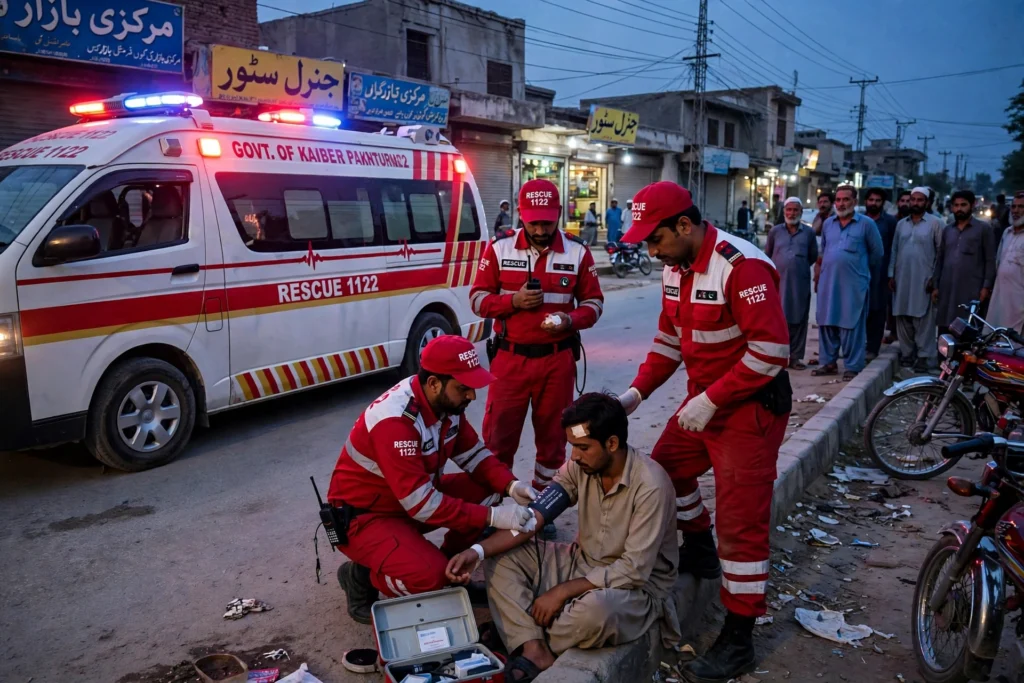
Rescue 1122 in Jhang district responded to 7,641 emergencies during October 2026, rescuing 7,661 people across road accidents, medical emergencies, fires and other incidents. The monthly figures were shared by District Emergency Officer Engineer Sultan Mahmood, who also reported that 144 people lost their lives during the month.
The control room received 33,079 calls in October. That total is far higher than the number of emergencies attended, and it is the reason behind the district emergency officer’s appeal to residents: the 1122 helpline should be used only for genuine emergencies, and unnecessary calls should be avoided so that help can reach people who truly need it in time.
Medical emergencies made up the largest share of the month’s work by a wide margin. Of the 7,641 emergencies, 5,794 were medical cases — roughly three out of every four incidents the service attended. Road accidents were the second-largest category, with 1,039 cases. The remaining incidents included 451 falls, 117 crime and violence cases, and 24 fire incidents, with the rest falling into other emergency categories.
What happened to the people rescued tells its own story. Of the 7,661 people rescued, 4,344 received first aid at the scene and were not taken to hospital, while 3,173 were shifted to hospitals for further treatment. The split shows how much of the service’s work is done on the spot: more than half of those helped were treated where the incident happened, by crews trained to stabilise patients before any hospital journey.
The average response time in urban areas remained 6.12 minutes. In an emergency, minutes matter — for a road accident victim, a heart patient, or a family calling about a fire — and a response time of just over six minutes in towns and cities is the standard against which the service’s performance is judged. The monthly report does not give a separate rural response time, so readers should not assume the urban figure applies equally across the district’s villages and far-flung settlements.
The 144 deaths recorded in October are a sobering part of the report. They sit alongside the rescue figures rather than apart from them: the same crews that saved thousands also attended incidents where, despite their efforts, lives could not be saved. The report does not break the deaths down by cause, and this article does not guess at that breakdown. What is clear is that road accidents and medical emergencies — the two largest categories — dominate the workload, and both are areas where early calls and quick first aid can make a real difference.
For Jhang’s residents, the practical message from the October figures is straightforward. First, know the number: 1122 is the single helpline for rescue and emergency medical help in the district. Second, use it only when there is a genuine emergency, because every unnecessary call ties up a control room that handled more than 33,000 calls in a single month. Third, when an incident happens, give clear information about the location and what has happened, so crews can reach the spot within that six-minute urban average rather than losing time searching.
October’s figures also give the district a baseline to measure the months ahead against. If November’s report shows a similar pattern, medical emergencies will again dominate, and the questions worth asking will be about prevention as much as response: road safety on the district’s highways and rural roads, first-aid awareness in homes and workplaces, and fire safety as winter sets in. For now, the October report stands as a record of a service that was called upon more than 7,600 times in 31 days — an average of roughly 246 emergencies a day — and answered every one of them.
Source: Associated Press of Pakistan via UrduPoint, “Rescue 1122 Responds To 7,641 Emergencies In Jhang In October, 144 Die”, published 4 November 2026.