
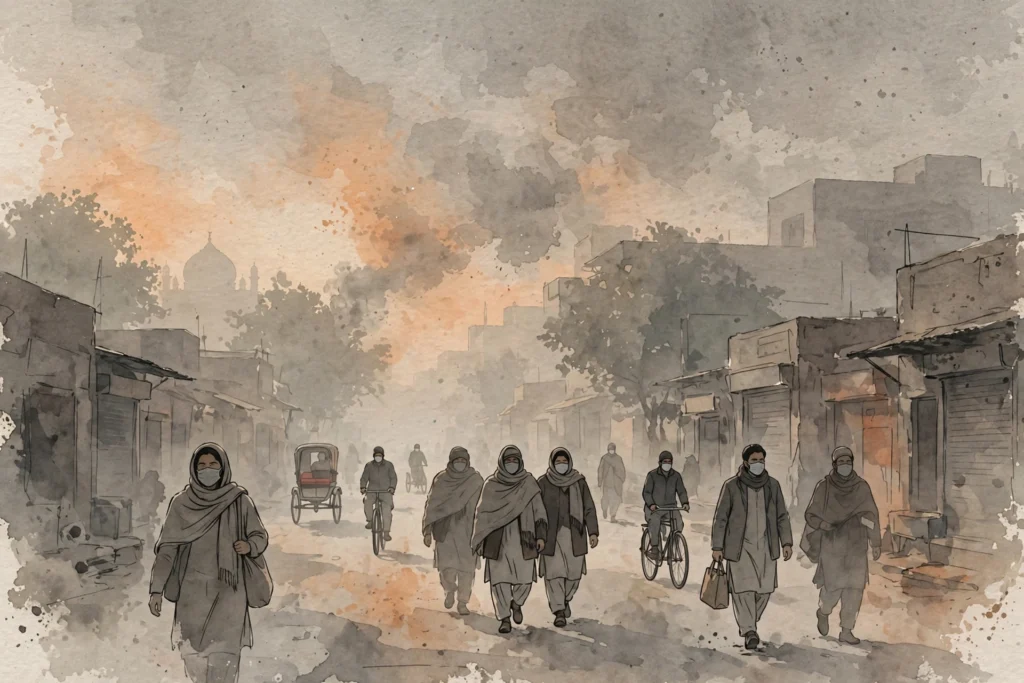
Jhang woke on Sunday morning to some of the dirtiest air of the smog season so far, with the Punjab government’s own monitoring putting the district at an Air Quality Index (AQI) of 297. The figure, reported on 1 November 2026, places Jhang among the worst-affected districts in the province on a morning when Lahore was ranked the world’s most polluted major city. According to the Punjab government’s AQI report for Sunday morning, Gujranwala recorded the highest reading in the province at 500, followed by Lahore at 478 and Sheikhupura at 336. Nankana Sahib registered 326, Dera Ghazi Khan 317 and Hafizabad 312, with Jhang next at 297 and Khushab at 273. A reading approaching 300 is air that health experts say can affect the entire population, not only people already sensitive to pollution.
Lahore’s position at the top of the global ranking came from a different monitor. IQAir’s global rankings put Lahore at 420, ahead of Tashkent at 196, Karachi at 170, Dhaka at 166 and New Delhi at 156. The Punjab government’s Lahore figure of 478, recorded at 7 am, was higher still, and several Lahore monitoring stations were reported at 500. The gap between the two Lahore numbers is a useful reminder: different monitoring systems measure at different places and times, so their figures are not directly interchangeable.
Readers who followed this site’s morning weather report may notice a different Jhang number there. That report gave a live reading of 210 for Jhang Sadar in the morning from another source, in the “Very Unhealthy” band. The 297 figure comes from the Punjab government’s provincial dashboard, reported later in the day by Daily Pakistan and corroborated by other outlets carrying the same provincial figures. The two systems do not have to agree to the last point to tell the same story: by every monitor quoted on 1 November, Jhang’s air was unhealthy, and on the provincial dashboard it was close to the hazardous threshold of 300.
Why is the air this bad now? The reports point to a familiar combination rather than a single cause: near-stagnant wind that lets pollutants sit close to the ground, high humidity that adds to the haze, and the usual seasonal sources — vehicle emissions, industrial activity, dust and burning. Jhang has its own contribution to the regional picture, and it was quantified only days ago: satellite data analysed by environmental monitoring website HamariHawa, and reported by Dawn, counted 676 crop-fire detections in Jhang district between 1 and 29 October. That October burning, covered in detail on this site on 31 October, is part of the smoke load now hanging over the province.
The enforcement side of the story continues in the background. Punjab’s Environment Protection Agency has been running a pre-smog enforcement campaign, and the provincial government has deployed quick response units, drones and night squads to track crop-residue burning through satellite detection. Those measures may reduce emissions over time, but they cannot clear air that is already loaded with smoke — and with the wheat-sowing window now open from 1 to 20 November, the pressure on farmers to manage stubble without burning is at its peak.
For Jhang residents, the practical advice in Sunday’s reports is unchanged and worth repeating plainly. Avoid outdoor exercise on high-smog days, limit unnecessary time outside, keep windows closed during the worst hours, and wear a well-fitting protective mask when going out is unavoidable. Children, older residents, pregnant women and people with asthma or heart disease face the greatest risk, and prolonged exposure to fine particulate matter is associated with breathing difficulties and worsening respiratory and heart conditions.
One caution is also in order. No new official school-closure order for Jhang was reported in the 1 November smog coverage checked for this article. Parents should rely on official notifications from the Environment Protection Agency and the School Education Department, and on their own school’s instructions, rather than on social media rumours.
Jhang’s 297 is not the province’s worst figure, and that is cold comfort. It sits just below hazardous, recorded on a morning when the provincial capital topped a world pollution ranking. The smog season is now fully under way, and Jhang is squarely inside it.
Source: Daily Pakistan, “Lahore again tops World’s Most Polluted Cities as Toxic Smog pushes AQI crosses 400”, published 1 November 2026, reporting Punjab government AQI figures and IQAir rankings; same provincial figures corroborated by NewsGuru and Suno News, 1 November 2026.
